About Tilden Technologies, LLC
Tilden Technologies, LLC is the father and son operation of Larry and Tom Young. We are "car guys" and engineers with an interest in camshaft design, valve train dynamics, and numerical methods (well, at least Larry). Tom comes from a traditional mechanical engineering background at a name brand university, but Larry's educational background is nontraditional for a cam designer. Our automotive interests are also nontraditional. For both of us, our first automotive exposure was to the Model T Ford that belonged to Larry's father (Tom's grandfather). Of course, the Model T wasn't fast enough in our youths, so Larry branched off into British sports cars and Tom into turbocharged Saabs. We're interested in old Fords, British Cars (especially Triumphs) and Saabs. We've never owned a small block V8.
Camshaft Design and Valve Train Dynamics
Our interest in cams and camshaft design goes back to 2000. Larry was part of The Cam Project, an effort by enthusiasts to make new camshafts for the Model T Ford. Larry was assigned the task of designing the lobes for the new camshafts. After a crash course in cam design and help from other project members, we developed three new grinds. These have been very successful and since 2001 roughly 1,000 of these new Model T cams have been manufactured by Specialty Motor Cams. Since the three original cams, we have been involved with the development of four other Model T cams, two for the Montana 500, one improved touring cam and one for OHV heads, Frontenac, Rajo or Roof. We have also developed a couple of cams for the flathead Ford V8 engine.
 After
the Model T Cam Project we studied everything we could find about
camshaft design methods, design history and valve train dynamics.
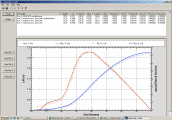
We developed a sophisticated cam design program, using the intelligent
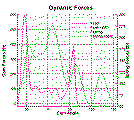
application of splines (click at left) and an advanced simulator of
valve train dynamics using the Orthogonal Collocation method for
spring dynamics (click at right). Our interest in cam design
was further heightened when we purchased a 1959 Triumph TR3A and
started vintage road racing in 2001. Development of an improved
camshaft was an obvious way to go faster and it gave us a chance to
try out what we had developed. This lead to the development of
5 different Triumph cams which have been produced for many different
Triumph racers (see Testimonial page).
After
the Model T Cam Project we studied everything we could find about
camshaft design methods, design history and valve train dynamics.
We developed a sophisticated cam design program, using the intelligent
application of splines (click at left) and an advanced simulator of
valve train dynamics using the Orthogonal Collocation method for
spring dynamics (click at right). Our interest in cam design
was further heightened when we purchased a 1959 Triumph TR3A and
started vintage road racing in 2001. Development of an improved
camshaft was an obvious way to go faster and it gave us a chance to
try out what we had developed. This lead to the development of
5 different Triumph cams which have been produced for many different
Triumph racers (see Testimonial page).
Most automotive enthusiasts are easily exploited because they don't understand camshafts and cam design. We have developed this website to share what we have learned.
Custom Cam Design
Do you have a car that is not mainstream, such as an older sports car? Do you have special engine requirements, such as one that is hopped up for vintage racing? Are you tired of using a cam grind that is recycled from a mainstream engine, such as a SBC? Was your engine and cam detuned to meet 1970's pollution controls?
If you are in this situation and need a custom cam design, then we may be able to help. On occasion we have designed cams that are tailored to a specific engine, not a grind that is recycled from some other engine.
Numerical Methods
Larry got his start with numerical methods back in the 1970's using the Orthogonal Collocation method. When this method was picked up for simulating valve spring dynamics, he realized that some aspects of the method were never explained. For this reason, he developed a hands-on tutorial on the method which includes downloads of code in Fortran 90, Matlab/Octave, C++ and Excel.
Vita Larry Young
Larry received a B.S.Ch.E from Texas Tech in 1970. An M.S.Ch.E in 1972 and Ph.D. in Chemical Engineering in 1974 both from U. of Washington. He spent 1975 thru 1983 in the Research Department at Amoco Production Co. working in petroleum reservoir simulation and enhanced oil recovery. In 1984 he founded Reservoir Simulation Research Corp. with a principal business of development and licensing of reservoir simulation software. After selling the company in 1996 and a brief period with the successor company, he retired from full time work.
Vita Tom Young
Tom received a B.S.M.E. from Rochester Institute of Technology in 2004. Since then he has worked in mobile computing with Touchstar Solutions, design of weight training equipment with Nautilus and currently with solar energy systems first with DPW Sola and now with Unirac.